
What I Want People To Know About My Invisible Disabilities
My courage is visible. My invisible disabilities are not.
This is my sixth year writing for Invisible Disabilities Week. My entry for 2020 is called Invisible Disabilities: Did You Know?
When you see me, it’s unlikely you can tell I’m disabled. This is because when I do leave my home, which is quite rare these days, especially in the past four years, I’m having a day with low disease symptoms.
This means I’m still in pain, but my symptoms are allowing me out of my house. You’ll never see me on high pain days because I can’t get out of bed, and it’s impossible to sit up or hold a conversation with someone.
I live with inflammatory arthritis (Axial Spondyloarthritis and Psoriatic Arthritis), fibromyalgia, and MECFS, which are my primary diagnoses.
I have a lot of secondary diagnoses that are also invisible but disabling: migraine, IBS, insomnia, and never-ending chronic pain are some examples.
Arthritis makes life difficult for me in many ways. I snap, crackle and pop like a bowl of Rice Krispies. Despite being 46 years of age, I move like I’m 90 years old. I’m stiff and in pain with hot, swollen joints all the time.
And then there’s fibromyalgia, which causes widespread skeletal and muscle pain that makes me feel like I’ve been beaten to within an inch of my life every single day. MECFS and fibromyalgia are very similar in symptoms and they cause cognitive issues and chronic fatigue. I’m not talking about being exhausted from life.
I’m talking about autoimmune fatigue that sucks the life out of you. No amount of sleep and rest will ever allow me to recharge my body. I live with an energy deficit and, for me, that means that if I surpass my energy envelope, I will crash and suffer the payback, which is an increase of symptoms related to pain and fatigue.
What does it take to get through the day with invisible disabilities? It takes visible courage.
Each day I wake up in pain all over my body at 4:30am. I try my best to go back to sleep, but usually wake up again at 6:30am in a massive amount of pain. From then on, it’s a battle to get out of bed. It can take hours.
After I get out of bed, I try to take a short five-minute walk because it’s important to move when you have arthritis. If you don’t, you get stiff and it becomes more painful and eventually you stop moving completely and end up in a wheelchair. But the strange thing is that fibromyalgia and MECFS hate movement, so if I do too much at one time, I get sick.
The crash that I experience from too much movement and activity – and this includes mental activity as well – is called a PEM crash. Post exhertional malaise occurs when I’ve done too much activity or if I’ve overdone things with mental work or experienced too much stress. In short, a PEM crash is exactly what it sounds like.
Post-exertional malaise (PEM) refers to a worsening of ME/CFS symptoms after minimal physical or mental exertion, which can be delayed 24-72 hours or more
Source: https://me-pedia.org/wiki/Post-exertional_malaise
My PEM crashes almost always happen 72 hours after activity.
I always get to the point where I think I’ve escaped it and then I get really sick. It feels like I have the flu, I get nauseous, I get a migraine or intense headache, I have extreme brain fog, photophobia and intense sound sensitivities that can be caused by something as small as spending too much time in the car or lifting some laundry that perhaps was heavier than I guessed.
My pain and fatigue get worse. I lose the ability to move, it gets harder to speak and think clearly. Basically I have to stop everything and let my body rest because it’s telling me no more. I can forget about trying to do anything for a few days. After the crash eases a bit, I can usually go back to having enough energy to wash my hair and get cleaned up. Sometimes I don’t.
Overall, I try to wash my hair twice a week and make it as easy as possible since it’s hard for me to keep my arms above my head for too long. (That’s arthritis for you.) Plus using my arms uses energy and that can also lead to a PEM crash, so you can see that the cycle is vicious and unavoidable.
My diseases impact every single aspect of my life.
When people tell me, ‘Oh, you talk so much about being sick‘, I hope you understand that this is my life.
While you’re sharing photos of your outings with your kids or traveling or eating out, I’m at home resting. For years now, I’ve been lucky if I can leave my home once a week for a few hours at a time. The payback is fierce.
So this IS my life and I will talk about it as much as I want.
Because my diseases impact my daily life, I experience pain everywhere and crushing fatigue; I have idiopathic insomnia; I experience cognitive difficulties and digestive issues. I have depression and terrible anxiety.
When daily habits that we take for granted like showering, making food, driving, doing groceries – when these types of things become harder to do – that’s a disability!
It takes courage to get through this!
I am a goddamned warrior for continuing to battle through these illnesses after 16 years of being very ill. I’ve got hundreds of hospital and ER visits logged in my medical history with dozens of different kinds of medications. I’ve experienced weight loss and weight gain, hair and nails falling out, pushing through trying to get food into myself. And I’ve done all of this while pushing myself to work to to pay for my treatments.
No one can ever call me cowardly or weak. I’m tough as nails.
I have limitations and I try to respect my limits with invisible disabilities, but sometimes I fail and get moody and emotional.
Most days I am simply not well enough to participate in activities or go to special events. I still commit to going to something special, but always with the caveat that I know I might have to cancel last minute.
Believe me! I want to be there. But chronic illness is unpredictable. My health can go from ok to very bad in under an hour. That means I’m a no-show for many things.
I pace myself by sticking to strict limitations so I can manage my pain. For example, I never go past 3,000 steps per day because if I do, I’m going past my energy envelope. Doing so will definitely result in a PEM crash. Some days I don’t move at all.
Sometimes I fail with my limitations and this can be easy for others to spot. For example, it’s not uncommon for me to get really emotional and start to cry over nothing when I’ve hit the end of my energy reserve. I was with friends the other day and got very emotional. It was clear to me that I was at the end of my energy limit. It was time to go home and my body was making sure everyone else knew too.
If you see me out and you can see me getting cranky or in distress, it’s time for me to leave. I hope you can understand that.
Mood swings and depression go hand in hand with chronic pain. Plus pain puts us on edge all the time.
You should encourage me to get out of my house when I feel that I’m able to
My husband is getting very good at this! Lately he has been reminding me that I need to seize those good moments when I can and leave my home. He knows the price I pay when I do this, but he also says my mood is improved when I’ve gone out to see some of my favorite people.
He encourages me to try and go for an hour or so and he’ll support me by driving me there or picking me up so I don’t have to navigate Taipei’s inaccessible streets.
My mom also encourages me to make an effort to see people when I can. And, of course, my friends offer to visit often.
Stop the stigma and support people with invisible disabilities
I’ve had people that showed disbelief when I told them I was disabled. People have judged me at the airport for using flight assistance.
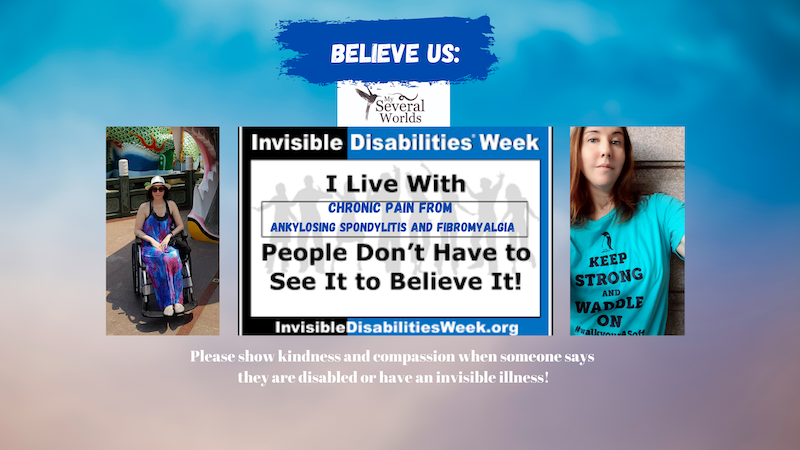
I can’t express how frustrating it is to live in a world where these types of things happen to people who are already fighting so hard to live their lives. It’s important that you believe us and support us.
I’m lucky to have people in my life that understand what life is like with invisible disabilities. But I still hear that ‘I don’t look sick’ or ‘they’d never know if I didn’t tell them’. This is why I’m so vocal about living with invisible illness.
When we share our stories, it helps to normalize what we’re going through and reinforces that fact that there are millions of us everywhere living lives that are quite different to what yours might be.
We need you to help us make an able-bodied world more accessible. It’s important that we ALL have access to living our lives with as much freedom as possible.
Disabled people need patience, compassion, and understanding.
We need you.
Read my articles about life with invisible disabilities here:
- Wheelie Life: Essential Questions From New Wheelchair Users [2024]
- The October Slide and Invisible Disabilities Week [2022]
- What I Want People To Know About My Invisible Disabilities [2021]
- Invisible Disabilities Awareness – Did You Know? [2020] This article is a fact-based research post that includes information about invisible disabilities.
- Believe Us Invisible Disabilities Awareness Week – Why Is It So Hard For People To Believe Us? [2019]
- Invisible in Taipei: What It’s Like Living in Taipei with an Invisible Disability [2018]
- International Day of Persons with Disabilities [2020] This article highlights the lack of disability awareness in Taiwan
Related Posts:


Carrie
I’m a chronically ill and disabled Canadian writer, patient advocate, international businesswoman, artist, and lifelong geek at heart.I lived in Taiwan for 23 years before repatriating to Canada at the end of 2025. My Several Worlds began as a travel and expat blog, but over the years it has grown with me through chronic illness, disability awareness, advocacy, business ownership, systems change, and the messy business of rebuilding a life when your body and the world around you do not always cooperate.I’ve lived several lives in one body. I built a massive international recruiting business called Reach To Teach Recruiting, became a professional writer and patient advocate, and somehow ended up as a chronically ill systems nerd who gets wildly excited about websites, healthcare policy, research rabbit holes, cats, and whatever is blooming in my garden.I’ve also modeled in Canada, China, and Taiwan, including one very memorable Discover Taipei cover involving a pineapple, which I still consider peak expat achievement.I’m a bit of a jack of all trades and a self-professed autodidact. I love art, flower arranging, reading — which is an understatement if you’ve seen my Goodreads profile. I have a special place in my heart for science, technology, law, health and medicine, history, disability policy, and culture.Animal videos make me cry. I hate cooking. You can find me nerding out at home most of the time due to being mostly housebound. If I'm not engaged in one of the activities listed above, I'm probably building websites.Check my About page to learn why I’m taking you on this journey with me through My Several Worlds.


