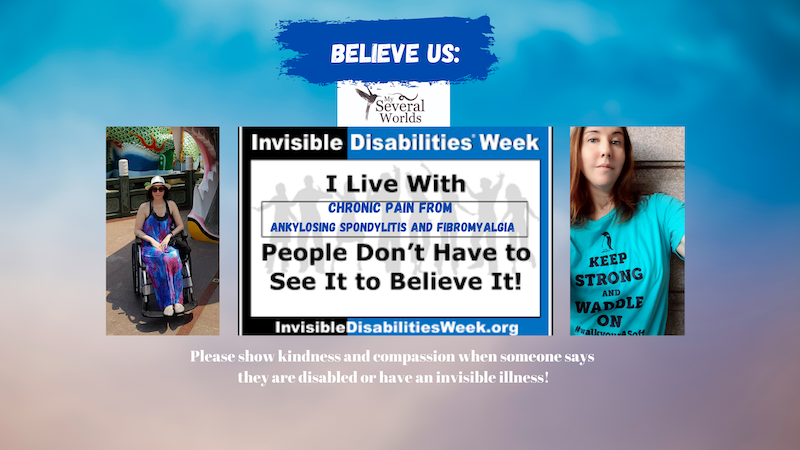
This is a time of year when disabled patient leaders around the world work together to raise awareness for people living with Invisible Disabilities.
Invisible illness advocates from around the world and in our communities are working to create awareness about what life is like with invisible illness and invisible disabilities.
I’ve participated in this event since 2015 because I have several invisible illnesses. I don’t look disabled. I was diagnosed with Ankylosing Spondylitis in early 2009.
[bctt tweet=”I’ve participated in #InvisibleDisabilitiesWeek since 2015. As many of you know, I have several invisible illnesses. I don’t look disabled. I have Ankylosing Spondylitis and fibro.” username=”@globetrotteri”]
By the end of 2014, my medical team had added Fibromyalgia and ME/CFS to my list of growing health issues.
Pacing is a technique I’ve employed for close to six years now. I use it to manage how much energy I’m expending each day. It helps to prevent flare-ups of disease symptoms.
Pacing is one way that I cope with chronic illness.
[bctt tweet=”Pacing for pain management is crucial to my lifestyle, and without some sort of plan in place for each day, my life can quickly spiral out of control.” username=”@globetrotteri”]
Today’s post is going to be a hard one. I’m writing about some of the ways I’ve been treated since becoming sick.
Most of the time, people see me and think nothing is wrong with me. Millions of us are in this situation. This puts people with disabilities at a higher risk of abuse, neglect, and being victims of crime.
Current statistics show that disabled people are four to ten times more likely to be victims of crimes than people without disabilities are. (Source: https://www.disabilityrightsca.org)
The best thing you can say to anyone with an invisible illness is:
‘I BELIEVE YOU’
You have no idea how three simple words can validate another person’s lived experiences while also demonstrating compassion and understanding. You can read more about my invisible disabilities here. Learn about what people like me go through in a world that is not built for us.
Please be aware of people with invisible illnesses and disabilities. Not all of us are visible. Below, you’ll find some of the horror stories I’ve had to live with as a disabled person.
I am an ambulatory wheelchair user. I use my wheelchair for long periods of time, but I can stil walk and stand a bit.
My limit is 3,000 steps per day or 22-30 minutes on my feet per day. That is literally all I can do.
[bctt tweet=”I need to be vocal about my disability because I don’t look sick. You will never see me on days I do look sick because those are the days I don’t leave bed. You can tell on those days.” username=”@globetrotteri”]
When you have an invisible chronic physical condition such as ankylosing spondylitis, rheumatoid arthritis, endometriosis, ME/CFS, fibromyalgia, it is hard! We don’t get to ‘come out’ about our disabilities.
Most people don’t recognize we are sick and disabled. This is so important to listen and hear when a person says they are disabled and can’t do something.
No one sees how sick I am or how hard my life is. My life is affected every day because of this.
Invisible Illness Awareness Week
Not all invisible illnesses and disabilities are visible!
Here are some examples of how I have been treated in and out of my wheelchair.
Accused of abusing flight assistance because I ‘don’t look like I need it.’
I stopped taking public transpo because people yelled at me for using the priority seats
I’ve had people sit on me in the hospital waiting room because I look young. People thought I was being disrespectful by not giving up my seat.
I’ve had people move my wheelchair without my permission.
Transported by animal cargo in Manila because the airline was not prepared for disability services
I had a Toronto Pearson airport porter yell at me for the 20 minutes because he didn’t want to transfer terminal 1 to terminal 2. I paid him three times his normal fee. He abused me the entire time and called me a liar. I was told I was dumb for not to give myself enough time between flight transfers. He took off with all my personal belongings while my assistant was running to catch up.
People have threatened to move me physically because I was ‘in the way’.
I’ve had able bodied people ignore my requests and make decisions for me
I’ve had people step in front of me at disability elevators because they didn’t want to take the stairs. They did not believe I needed to use the disabled elevator.
Disabled parking spots in the US and Canada? Don’t get me started. Heaven forbid you don’t at least have a cane as proof.
Please show kindness and compassion when someone says they are disabled or have an invisible illness
I’d also like to mention awareness for other large groups of people with hidden illnesses/disabilities that are often overlooked:
the blind and hearing impaired
people living with HIV/AIDS
anyone who falls on the autism spectrum
cystic fibrosis
epilepsy
brain injury, and of course
any kind of psychiatric illness
There are so many, I can’t fit them all here, so again AWARENESS MATTERS
We all try so hard every day to keep things normal and to fit in. It’s time to recognize the efforts we make to live in a world that is not made for us.
Read my articles about life with invisible disabilities here:
I’m a chronically ill and disabled Canadian writer, patient advocate, international businesswoman, artist, and lifelong geek at heart.I lived in Taiwan for 23 years before repatriating to Canada at the end of 2025. My Several Worlds began as a travel and expat blog, but over the years it has grown with me through chronic illness, disability awareness, advocacy, business ownership, systems change, and the messy business of rebuilding a life when your body and the world around you do not always cooperate.I’ve lived several lives in one body. I built a massive international recruiting business called Reach To Teach Recruiting, became a professional writer and patient advocate, and somehow ended up as a chronically ill systems nerd who gets wildly excited about websites, healthcare policy, research rabbit holes, cats, and whatever is blooming in my garden.I’ve also modeled in Canada, China, and Taiwan, including one very memorable Discover Taipei cover involving a pineapple, which I still consider peak expat achievement.I’m a bit of a jack of all trades and a self-professed autodidact. I love art, flower arranging, reading — which is an understatement if you’ve seen my Goodreads profile. I have a special place in my heart for science, technology, law, health and medicine, history, disability policy, and culture.Animal videos make me cry. I hate cooking. You can find me nerding out at home most of the time due to being mostly housebound. If I'm not engaged in one of the activities listed above, I'm probably building websites.Check my About page to learn why I’m taking you on this journey with me through My Several Worlds.
To provide the best experiences, we use technologies like cookies to store and/or access device information. Consenting to these technologies will allow us to process data such as browsing behavior or unique IDs on this site. Not consenting or withdrawing consent, may adversely affect certain features and functions.
Functional
Always active
The technical storage or access is strictly necessary for the legitimate purpose of enabling the use of a specific service explicitly requested by the subscriber or user, or for the sole purpose of carrying out the transmission of a communication over an electronic communications network.
Preferences
The technical storage or access is necessary for the legitimate purpose of storing preferences that are not requested by the subscriber or user.
Statistics
The technical storage or access that is used exclusively for statistical purposes.The technical storage or access that is used exclusively for anonymous statistical purposes. Without a subpoena, voluntary compliance on the part of your Internet Service Provider, or additional records from a third party, information stored or retrieved for this purpose alone cannot usually be used to identify you.
Marketing
The technical storage or access is required to create user profiles to send advertising, or to track the user on a website or across several websites for similar marketing purposes.
 This is a time of year when disabled patient leaders around the world work together to raise awareness for people living with Invisible Disabilities.


