
Invisible Disabilities Awareness – Did You Know?
Invisible Disabilities Week is coming up on October 18-24th, 2020. I’ve participated in this awareness campaign since 2015. This year, I’m adding to my annual campaign with some basic stats. As I’ve gotten further into my own personal journey with disability and life in Taiwan, I’ve recognized a greater need for awareness here. My goal with My Several Worlds, as always, is to create a safe space in Taiwan and in Asia where patients can come together to share knowledge and be supported.
October is a big month for me. In addition to celebrating Invisible Disabilities patients this month, we’re also celebrating World Mental Health Day on October 10th AND World Arthritis Day on October 12th.
To those of you who are new here, I’m Carrie and I’ve been living with Anklylosing Spondylitis (axial Spondyloarthritis for those of you who know that the term has been updated!), Fibromyalgia, and MECFS as primary illnesses since 2009.
Since these diseases also have an autoimmune aspect to them, you’re probably aware that chronic illnesses tend to group together. It’s not uncommon for patients like me to receive new diagnoses each year.
Like so many Spoonies, I struggle to find words to describe what my life is like living with severe limitations and daily chronic pain.
I’m mostly housebound and count myself lucky if I can leave my home twice a month for two hours at a time. Things got real in the summer of July 2014 when I came out of remission with AS and my fibro and MECFS ramped up. That’s when we knew for certain that I would be relying on mobility aids more frequently.
It’s a known fact that a large part of the chronic illness community is living with an invisible illness or invisible disability. A great number of invisible disabilities are usually caused by chronic illness or chronic pain. According to DisabledWorld.com, 96% of people that live with chronic medical conditions are also living with an invisible disability.
This means that you’re living invisibly with something that impairs your ability to do ‘normal activities’ each day. And since people can’t see it, that makes life doubly hard.
As an ambulatory wheelchair user, I can pass between both worlds. I am capable of standing and walking for a bit, but anything past 22 minutes on my feet usually lands me on ice packs and in bed for days. I simply don’t have the strength to stand or walk for long periods of time.

There are many reasons why a person could be an ambulatory wheelchair user.
Some patients might have lower body injuries. Maybe they’re unsteady on their feet. Maybe they are fighting pain so hard every day, they simply don’t have the strength to put into walking or standing like other people do.
To make things worse, we are harassed when we don’t fit society’s idea of what ‘disabled’ looks like. We’re harassed or discriminated against if we don’t look like we should be in a wheelchair.
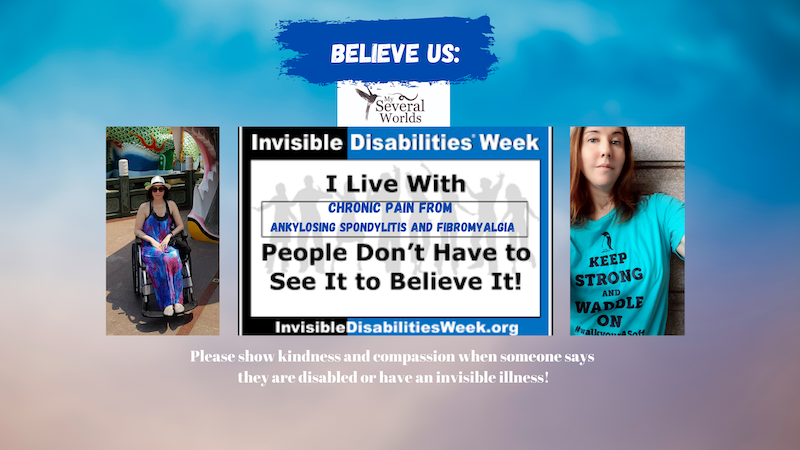
In the photo above, I can tell you that even going up on my toes for less than a minute to take that photo was very painful, but it looks effortless, doesn’t it?
We don’t get to come out with invisible disabilities, which is why it’s so important that we continue to advocate and raise awareness. You can’t tell if someone is blind or deaf or impaired simply by looking at them. Additionally, a great number of us who are sick don’t look sick!
Definition of an Invisible Disability
People often ask us to define invisible disability. In simple terms, an invisible disability is a physical, mental or neurological condition that is not visible from the outside, yet can limit or challenge a person’s movements, senses, or activities. Unfortunately, the very fact that these symptoms are invisible can lead to misunderstandings, false perceptions, and judgments.
InvisibleDisabilities.org
Invisible disabilities can be physical, cognitive, mental, sensory, emotional, developmental, or a combination of all of these. Some people have disabilities from birth, while others experience it later in life, either by accident or through illness. Disabilities cover everything from impairments, activity limitations, and restrictions in being able to participate.
Without a doubt, a disability, whether visible or not, affects an individual’s quality of life. While most of us find new ways to get around in a world that is made for able-bodied people, there are clear disadvantages to living with a disability.
How Common are Disabilities?
Two in 10 adults live with a disability! Think about that. Think of all the people you know. At least two out of every 10 adults that you have in your life are living with a disability.
The most common disability type, mobility, affects 1 in 7 adults. With age, disability becomes more common, affecting about 2 in 5 adults age 65 and older. “At some point in their lives, most people will either have a disability or know someone who has a one,” said Coleen Boyle, Ph. Disability is especially common in older adults, women and minorities.
CDC.gov
In America, 30.6 MILLION people have difficulties navigating stairs and walking. Millions of people also suffer from agility issues such as carrying lifting, reaching and bending.
In Taiwan, the stats are dismal and out of date. I couldn’t find anything more recent than 2008 that shows one million people living with disabilities that impair their ability to navigate stairs. For reference, the population of Taiwan is 23.4 million. That number is surely higher a decade later, especially with Taiwan’s aging population.
Mental health issues are also a considered to be an invisible disability. For example, in any given year in Canada, 1 in 5 people in Canada experiences a mental health problem or illness. Over 2 million Canadians have a mental health-related disability. In Taiwan, mental health is highly stigmatized. It isn’t talked about much.
What are some examples of invisible disabilities?
Invisible disabilities are easy to overlook and they are often misunderstood. For patients living with an invisible disability, we frequently experience discrimination and or complete exclusion trying to prove that we are, in fact, disabled!
The list of hidden disabilities is long. This list is not exhaustive. If I’ve left something out, don’t worry. I see you. We hear you. I know you’re there. You’re not alone. Here’s a link to a complete list of invisible disabilities.
Invisible Disabilities – Examples
| Deaf or Hearing Impaired | Blind |
| Arthritis & musculoskeletal health problems | Autism |
| Cancer | Chronic Fatigue Syndrome/Myalgic Encephalomyelitis |
| Chronic Pain | Crohn’s and other GI disorders |
| Cystic Fibrosis | Diabetes |
| Epilepsy | Fibromyalgia |
| Functional Neurological Disorder | Heart disease |
| HIV/AIDS | Lung or respiratory problems |
| Multiple Sclerosis | Nervous System Disorders |
| Traumatic Brain Injury | Many other examples… |
Psychiatric Invisible Disabilities – Examples
| ADD/ADHD | Depression |
| Bipolar Disorder | Schizophrenia |
| Anxiety | PTSD |
What Do Invisible Disabilities Have in Common?
Invisible disabilities are hidden. You can’t see an invisible disability, yet they are often permanent and must be coped with on a daily basis. The only time a disability becomes visible is when mobility aids are used or when we use sign language or a white cane for vision impairments. Not being seen, recognized, or included results in many patients feeling misunderstood, ignored, or invalidated.
Some of us never receive a diagnosis. Some of us never receive qualification from our doctors about our disabilities. Some of us DO have medical letters from our doctors and STILL can’t access disability rights and safe spaces.
ALL OF US face challenges daily, especially those of us with an invisible disability.
Carrie Kellenberger, My Several Worlds
What is Invisible Disabilities Awareness?
The biggest problem that people with disabilities face are other people and society’s ideas and expectations about the word ‘disabled’.
Disability awareness means educating people about disabilities. We desperately need more awareness and education in Taiwan. It is unacceptable to see how people are treated here.
Advocates are working towards normalizing disabilities and raising awareness about it so people have the knowledge required to do a job or task that takes disabled people into consideration.
In Taiwan, prior to 1980, the term ‘disabled’ translated to ‘useless and worthless disability.’ The government was not responsible for these people nor did they provide education or awareness programs or provide funding or support to disabled people.
Families and nonprofit organizations were responsible for supporting disabled people. To this day, the prevailing attitude towards disabled people is poor. Education and awareness in Taiwan is poor.
Awareness and advocacy are key here in Taiwan just like it is elsewhere in the world. It’s not enough to know that disability discrimination is against the law. Discrimination is still actively practiced here in Taiwan DESPITE the law.
Invisible Disability Awareness Week
Invisible Disability Week is an awareness campaign that I’ve participated for a decade. It helps to promote better community access for people with disabilities. It helps to normalize those of us living with an invisible illness or invisible disability. Our aim is to educate and inform.
Invisible illness and invisible disabilities are difficult to live with, not only because of the challenges we face daily on a personal level, but also because of the extreme ignorance we face on any given day.
Not looking sick enough is awful to deal with. On one hand, you can pass as a healthy person, but the other side is that when you need help, people won’t believe you.

A personal note about myself here: When I first mentioned being disabled in front of my mom a few years ago, her immediate reaction was, “No, you’re not. You’re not disabled, Carrie.”
I didn’t know how to respond to that, but after thinking about it, I think that reaction was just my mom being my mom and not wanting to be negative. It must’ve been a shock for her to hear me say that even though she knows about the daily difficulties I face. She has seen my PEM crashes and how activities like climbing stairs and walking long distances have made me worse since 2015. She knows I have issues with mobility (walking, standing, climbing stairs) and with agility (carrying, lifting, reaching and bending).
She knows I’ve used flight assistance to get home every year. And she’s my mom! She knows exactly what I’m going through. Maybe it’s I because I used the word ‘disabled’ in front of her and she just wasn’t ready to hear me describe myself that way?
But it’s true. And we need people to help us normalize this.
Like most patients with invisible disabilities, I have some real horror stories that make me very anxious every time I leave my house.
I’ve had to work at convincing people, including my own doctors, that I’m sick. A lot of people just assume you’re weak, lazy, or exaggerating. They might not see the physical signs that you’re suffering or in pain. They definitely don’t see the aftermath of what it takes to get through the day. I feel invisible in Taipei.
This kind of treatment chips away at you every day. It makes you feel defensive. It makes you not want to trust anyone. It fills you with dread, anger, and anxiety. It causes panic attacks, sorrow, and grief. It is traumatic. It sucks being judged by others when all you want to do is have a little normalcy in your life.
Never judge a person by what they look like!
If you take anything away from this article, please remember that disability does not depend on outward appearance. Remember that.
Don’t assume that you know what a person is going through based on their appearance. Society, as a whole, has real shortcomings in how disabled people are treated. We are actively fighting for better community access for people with disabilities.

Read my articles about life with invisible disabilities here:
- Wheelie Life: Essential Questions From New Wheelchair Users [2024]
- The October Slide and Invisible Disabilities Week [2022]
- What I Want People To Know About My Invisible Disabilities [2021]
- Invisible Disabilities Awareness – Did You Know? [2020] This article is a fact-based research post that includes information about invisible disabilities.
- Believe Us Invisible Disabilities Awareness Week – Why Is It So Hard For People To Believe Us? [2019]
- Invisible in Taipei: What It’s Like Living in Taipei with an Invisible Disability [2018]
- International Day of Persons with Disabilities [2020] This article highlights the lack of disability awareness in Taiwan
Related Posts:


Carrie
I’m a chronically ill and disabled Canadian writer, patient advocate, international businesswoman, artist, and lifelong geek at heart.I lived in Taiwan for 23 years before repatriating to Canada at the end of 2025. My Several Worlds began as a travel and expat blog, but over the years it has grown with me through chronic illness, disability awareness, advocacy, business ownership, systems change, and the messy business of rebuilding a life when your body and the world around you do not always cooperate.I’ve lived several lives in one body. I built a massive international recruiting business called Reach To Teach Recruiting, became a professional writer and patient advocate, and somehow ended up as a chronically ill systems nerd who gets wildly excited about websites, healthcare policy, research rabbit holes, cats, and whatever is blooming in my garden.I’ve also modeled in Canada, China, and Taiwan, including one very memorable Discover Taipei cover involving a pineapple, which I still consider peak expat achievement.I’m a bit of a jack of all trades and a self-professed autodidact. I love art, flower arranging, reading — which is an understatement if you’ve seen my Goodreads profile. I have a special place in my heart for science, technology, law, health and medicine, history, disability policy, and culture.Animal videos make me cry. I hate cooking. You can find me nerding out at home most of the time due to being mostly housebound. If I'm not engaged in one of the activities listed above, I'm probably building websites.Check my About page to learn why I’m taking you on this journey with me through My Several Worlds.


