
Let’s Talk About Pain – Chronic Pain Awareness
Chronic pain patients celebrate this month because September is Pain Awareness Month! I’ve participated in raising awareness for this month for close to a decade. I talk about pain and share my chronic pain story because when we share our stories about life with pain so we feel less alone. Invariably, we also end up helping other pain patients who are looking for information and help. It helps to know you’re not alone!
Writing about chronic pain not only informs other patients, but it also helps me cope with the enormity of my life grinding to a halt because chronic pain puts the brakes on everything in your life. It’s impossible to function or participate in life fully when pain is present.
Chronic pain patients experience stigma and shame daily because they are afraid to speak up about their experiences for fear of not being believed, for fear of being labeled as an addict or attention seeking, and for fear of others not understanding what non-stop pain means to those of us who suffer from it.

My chronic pain experience started over 25 years ago at age 22. What does pain really look like?

I sought help everywhere. No one could help me figure out why I was in so much pain until 2009, when I was officially diagnosed with Ankylosing Spondylitis.
By 2015, my medical team had added fibromyalgia, migraine, MECFS, chronic insomnia, MCAS, IBS, depression, and many other health issues that are secondary to my primary issues.
Having missed out on a timely diagnosis and treatment has affected my life in the worst ways.
No one took me seriously when I was in pain in my early 20s. I normalized my pain and convinced myself the agony I was experiencing after a run or gym session was normal and that everyone else felt the same way. I’d push through every week and then collapse on rest days, unable to move.
In July 2014, the pain was so debilitating that I couldn’t walk or stand for more than 20 minutes, and that is where I am today. Pain affects every aspect of my life: my day to day life, my ability to work, my marriage, my family and friendships; it affects me financially.
It also severely affects my mental health.
Chronic Pain Awareness Month
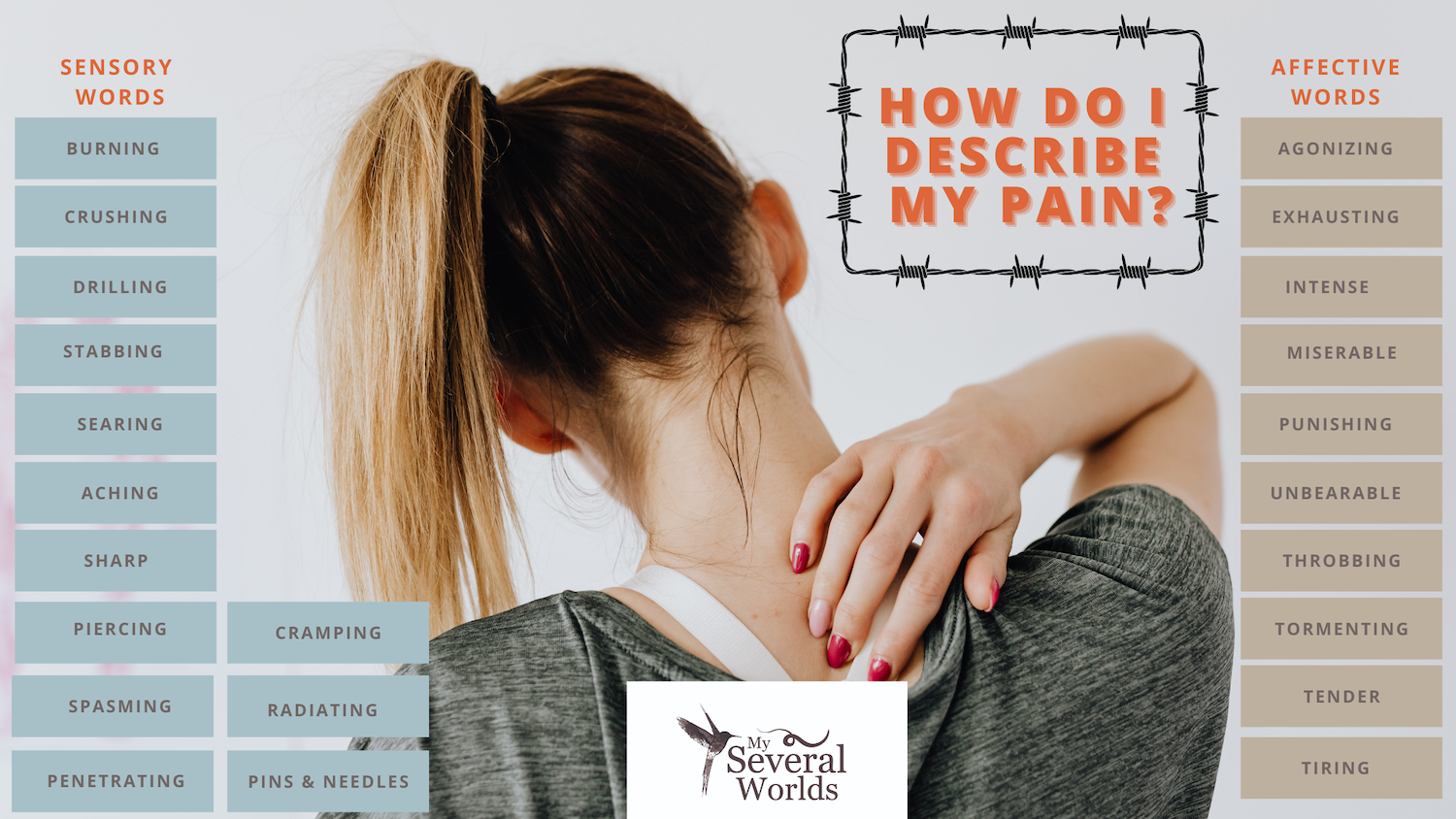
Stabbing, aching, burning, stinging, pins and needles, tightness, cramping, twitching, ripped, squeezing…
These are just a few words I use to convey how I feel during my hospital appointments.
And since we pain patients often have a hard time talking to our doctors about how serious our pain is, I’ve taken things just a little further to assist patients who are new to chronic pain and who are struggling to describe their pain to their doctor.
Here’s a post that might be helpful to you: How Do I Describe Chronic Pain To My Doctor?
My pain dictates what I wear, when I wash my hair, whether I eat, whether I can meet a friend for lunch or whether I can even get out of bed or leave my home. I spend most of my time in bed, which is where I wrote this article.

I hope for a few ‘normal’ hours with my husband each month. Before I got sick, I was extremely athletic and very successful with work. I’m housebound now and work from home.
Pain is all consuming. It’s bearable, slightly bearable, or completely unbearable. I don’t remember what it feels like to not be in pain.

Pain is isolating and lonely.
Chronic pain affects my life in profound ways. I spend a lot of time by myself. When it’s really bad, I don’t want to see anyone. Even the effort of sitting up and talking is too much for me to do. I don’t see my friends much. If I do, it’s never for more than a few hours.
I’m not capable of going to the beach, taking long walks, or shopping for groceries.
Pain patients give up everything to fight pain. From a mental perspective, pain is a battleground. It’s impossible to know when it will ease up for a bit. You lose your sense of self, your sense of purpose and worthiness. We experience a loss of independence.
It feels like you’re going crazy.
How much longer can I deal with this? Why is this happening to me?
Pain is mentally and physically exhausting.
Ten years has given me a lot of time to try new medications and many types of alternate therapies to find relief. I learned strategies on my own to manage my pain since none of my doctors have addressed pain management with me or helped me cope with the mental aspect of being in pain 24/7.
I’ve tried muscle relaxers, NSAIDS, DMARDS, opiates, anti-inflammatories, anti-depressants, anti-TNF medications, lidocaine patches, pain creams, epidural joint injections in my spine, medical marijuana, massage therapy, acupuncture, acupressure, TCM, and more.
My current pain treatment plan consists of an anti-TNF medication that helps stop my immune system from attacking itself, painkillers, muscle relaxers, sleeping meds, pain patches and creams, heat therapy, and stretching. I use distraction techniques to cope with my pain.
When it’s out of control, I need assistance at the ER. My current pain treatment protocol works to take the wild edge off of my pain. It doesn’t stop my pain completely.
If you’re in pain, here are some things that might help:
- Practice self-care and self-love. It’s not your fault you are in pain
- Learn how to say no and not feel guilty about it
- Take breaks when you need them and don’t push through things
- Never feel embarrassed about using mobility aids. The only way for me to travel or do a few hours outside is in my wheelchair. If a mobility aid is necessary and allows you to do more things, do it!
- Talk about your pain

“Talking about pain and raising awareness matters to me because pain is invisible and no one can see it.” Carrie, My Several Worlds
The biggest factor that has helped me on this journey is being able to share my story online and meet other people who are in chronic pain.
Talking about it connects me to other pain patients and helps me through bad days.
Being online is often my only connection to the outside world. Talking about it also helps others understand that they are not alone.
By sharing our stories, we can create awareness and positive change.
Chronic pain is devastating. It affects every single aspect of your life, and the only thing we can do is continue going, pick yourself up every day, and keep going.
You reach a point many times when you don’t know how to keep going, but you do.
This is what pain can look like.
We keep on going.
You are not alone.

Are you interested in reading more?
- How Do I Describe Chronic Pain To My Doctor?
- Costochondritis: Chest Wall Pain with Arthritis and Fibromyalgia [Written in 2021. Updated 2025]
- Fibromyalgia and Electric Shock Pain: Paresthesia [September 2023]
- How To Be A Friend To Someone Living with Pain
- Pacing for Pain Management [Written in 2015. Updated September 2023.]
- Red Light Therapy for Pain and Inflammation [Written September 2023]
- Foot Reflexology for Chronic Pain [Written 2022]
- How Do Compression Socks and Compression Sleeves Work For Pain and Blood Clots? [Written October 2025]
- 8 Ways Pain Changes You [2022]
- Unsolicited Health Advice From Online ‘Pain’ Specialists [2022]
- Life With Chronic Illness and Chronic Pain – Never Did I Ever Think [2017. Updated 2025]





Carrie
I’m a chronically ill and disabled Canadian writer, patient advocate, international businesswoman, artist, and lifelong geek at heart.I lived in Taiwan for 23 years before repatriating to Canada at the end of 2025. My Several Worlds began as a travel and expat blog, but over the years it has grown with me through chronic illness, disability awareness, advocacy, business ownership, systems change, and the messy business of rebuilding a life when your body and the world around you do not always cooperate.I’ve lived several lives in one body. I built a massive international recruiting business called Reach To Teach Recruiting, became a professional writer and patient advocate, and somehow ended up as a chronically ill systems nerd who gets wildly excited about websites, healthcare policy, research rabbit holes, cats, and whatever is blooming in my garden.I’ve also modeled in Canada, China, and Taiwan, including one very memorable Discover Taipei cover involving a pineapple, which I still consider peak expat achievement.I’m a bit of a jack of all trades and a self-professed autodidact. I love art, flower arranging, reading — which is an understatement if you’ve seen my Goodreads profile. I have a special place in my heart for science, technology, law, health and medicine, history, disability policy, and culture.Animal videos make me cry. I hate cooking. You can find me nerding out at home most of the time due to being mostly housebound. If I'm not engaged in one of the activities listed above, I'm probably building websites.Check my About page to learn why I’m taking you on this journey with me through My Several Worlds.


