8 Ways Chronic Pain Changes You
There are many ways chronic pain changes you, but today I’ve decided to focus on eight basic facts about life with pain. Today’s post is my second post this month for Pain Awareness Month.
Everyone has experienced some sort of pain at some point in their lives. Most of us are familiar with acute pain which is a person’s protective response to an injury. This type of pain typically resolves itself during the healing process. However, 1 in 5 people around the world experience pain that lasts for three months or more.Source
When pain persists for this length of time or longer, it’s considered to be chronic pain, and the sad news that we are all aware of is that doctors still don’t really understand chronic pain and we have limited resources to treat chronic pain.
Some people develop chronic pain because of an accident or injury that turns into long-term pain. Others suffer from diseases or disorders that cause chronic pain. Regardless of how your chronic pain has developed, there is no doubt that it disrupts lives and rips families apart.
Here are 8 ways chronic pain changes you
1. Chronic pain affects every aspect of your day to day life
Pain patients, whether they are suffering from acute pain or chronic pain, quickly realize that life as we know it changes immensely when we are living with pain. Think about a time when you sprained your ankle or hurt your knee and you’ll likely remember that for a long period of time, you were stuck on a couch and unable to do anything. Now turn that period of time into months and years and you have some idea of what pain patients live with.
Things that were once easy for you are now hard to do and close to unbearable. It’s a miserable way to live.
Chronic pain patients never escape this cycle. It’s hard to get up in the morning. Pain makes it hard to fall asleep or get good, restorative sleep. Chronic pain sucks up your energy and eats away at your ability to perform even the simplest of tasks, such as cooking, cleaning, or even going to the bathroom on your own. There is no aspect of life that is not affected when you suffer from chronic pain.
Pain patients learn coping techniques to deal with chronic pain and these techniques help to improve our quality of life. But obviously, every single one of us is waiting and hoping for better care, better understanding, and more treatment options so we can have better quality of life.
Pain can overwhelm a person easily. Days turn into months that turn into years. Years can become decades and during all that time, we’re learning various techniques to live with pain and ways to get through just one more day.
2. Chronic pain has lasting effects on your body
People living with chronic pain experience massive changes in their body, including de-conditioning, hormonal changes, and changes to their cardiovascular health for starters.
We become de-conditioned because pain often won’t allow us to do things. If we do participate in activities, activity tends to make us worse. Pain patients learn to avoid activities that make us worse. That’s not a wrong attitude to have because it’s crucial that we learn how to pace for pain in order to not spend every waking moment in bed.
However, in avoiding activities or withdrawing from activities, we also become less fit. Our muscles become weaker when we aren’t using them. We also tend to compensate for parts of our body that we can’t use. When we compensate in this manner, that can lead to unusual patterns of movement that can make us worse.
Pain changes our hormones. Our hormones control everything from our mood and metabolism to how we sleep. Chronic pain affects our endocrine system which leads to disturbances in our biological processes.
Additionally, excess cortisol is produced by pain and prolonged stress. We know that chronic stress resulting from excess cortisol can have negative impacts on the body. These impacts include disruptions with sexual disfunction, digestive issues, and a compromised immune system.
Pain patients typically struggle with hypertension. When high blood pressure is left untreated, it can lead to cardiovascular problems.
The bottom line? Pain patients must pay careful attention to the physical changes in their bodies.
3. Chronic pain limits your ability to work and earn money
This one is so unbelievably hard for all pain patients. We need money to pay for treatments that give us a break from pain and the cycle is vicious. Pain treatments are expensive and most of them are not covered by insurance.
More awareness is needed for workplace accommodations, but predictors of unemployment show that there are many challenges that patients must face at work. Some of the challenges have to do with restricted mobility while others are due to having to use public transportation, working somewhere that has not made special accommodations for pain patients, and it can even depend on the type of shoes you can afford.Source
Because chronic pain interferes with daily life, work obviously becomes much harder or even impossible, not to mention the loss of a social life and being able to care for and carry on relationships with others.
Pain impedes our ability to work and it also affects the quality of our work. And yet many of us must continue working because we have no other choices.
4. Chronic pain changes your personality
Chronic pain will change your personality. It makes us grouchy and emotional. It makes us depressed and anxious. Chronic pain causes disruption in our brains and neural pathways. Experiencing depression, anxiety, mood changes, emotional instability, and altered perceptions is very much the norm with chronic pain. It’s a direct result of the stress that impacts our bodies on a physical and chemical level.
Did you know that untreated chronic pain can impair your brain function? Up to two thirds of chronic pain patients have cognitive issues that include problems with cognitive processing and problems with memory and attention. Because chronic pain patients are often anxious and depressed due to pain, it’s of the utmost importance that doctors and specialists screen patients ahead of time to try and help before anxiety and depression become the norm.
Speaking personally, I am not the person I was before pain impacted my life and I will never be the person I was before pain became part of my every day life.
5. Chronic pain can affect your confidence
When you’re unable to participate in daily activities or even care for yourself because of chronic pain, it’s natural that pain patients lose confidence in themselves and in their ability to do things. Many pain patients rely heavily on their partners for care or to assist with chores they can no longer do. It’s hard to ask for help or even admit you need help when you are in pain.
How much confidence can a person maintain when they have to ask for help with everything? What about when you’re constantly worrying about how you’re going to continue paying for your health and what your future holds for you?
6. Chronic pain can change your relationships with others
Chronic pain WILL change your relationships. People will either try to understand what you are going through or they’ll leave.
Most pain patients have stories about being abandoned because loved ones and friends could not cope with the immense changes that happen to a person who is suffering physical pain. Myself included. In fact, I’ve been told straight up by a loved one that they’re sick of reading about my never-ending pain. And thus that relationship is gone because this person cannot even be bothered to maintain basic contact or ask a simple question, such as, ‘How are you today?’
For partners of pain patients, their lives are irrevocably changed when their loved one is suffering. They become full time caregivers and part-time partners.
Partners and family often bear the brunt of a patient’s emotions too. On high pain days, it’s our loved ones who are subjected to mood swings and irritability.
7. Chronic pain makes you fearful and scared
Wouldn’t you be scared of doing things if you were in pain? I tend to avoid a lot of things now because I’m scared to step out my front door. Inside my home, I can keep a modicum of normalcy about my life. Outside my home, anything can happen. I have zero control and have to think of everything in advance.
My husband and I both spend time sourcing a venue before we leave so we know what to expect. Are there are stairs? How far do we have to walk? Are the bathrooms accessible? Will we encounter anything that will make our time out more difficult? Those things add up quickly and they add to stress.
It’s terrifying not knowing what’s going to happen when you’re living with pain or when the pain is going to stop. It’s also terrifying to know that something might make your pain worse. You have no idea what will happen until it does.
8. Living with chronic pain requires a superhuman power of pain tolerance
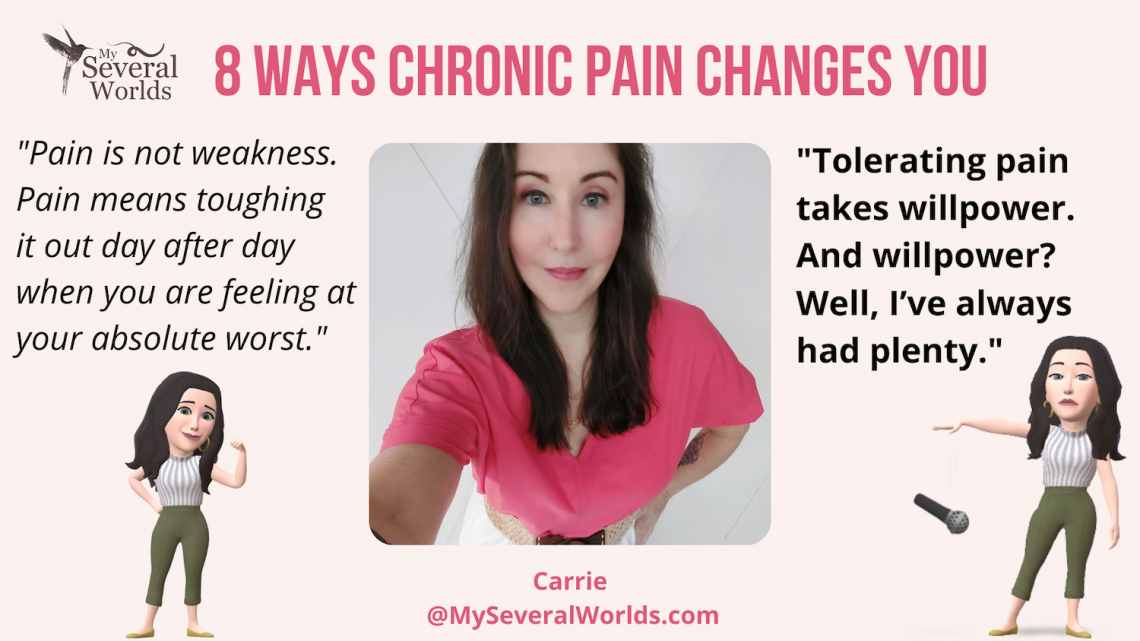
Living with chronic pain means pain patients develop an incredibly high tolerance for pain. Pain is not weakness. Pain means toughing it out day after day when you are feeling at your absolute worst. I can function on days with high levels of pain that would leave most people screaming in agony.
My tolerance for pain has increased over the past 15 years. I’m still experiencing the same high levels of pain I was living with in 2015, but I’ve got better coping techniques now that allow me to get through it. We learn lessons about our bodies that only world class athletes might be able to relate to. We persevere in things that would stop others in their tracks.
Tolerating pain takes willpower. And willpower? Well, I’ve always had plenty.
Positive takeaways to this article:
Although the ways chronic pain changes you might seem awful and unbearable, most pain patients have also expressed that pain has made them a better person in terms of empathy and understanding. It’s humbling to live with pain every day. It’s humbling to have to ask for help and to realize that things you used to take for granted are no longer a part of your life because you can no longer do them.
In many ways, I feel that my growth as a person can be attributed to learning to live with chronic pain.
Would I like the pain to stop? Absolutely. But I’m also grateful for the lessons my life with pain has taught me.
Additional Reading Resources:
- Potential Complications of Untreated Chronic Pain – Painscale.com
- How Do I Describe My Chronic Pain To My Doctor – MySeveralWorlds.com
- A Picture of Pain: What Life is Really Like with Chronic Pain – Pfizer.com (with additional resources)
- What Does Chronic Pain Do To A Person – Pathways.health
- How Chronic Pain Changes Your Brain and Personality – NeuRA Edu
- Surprising Ways To Hurt – Pain Science




Carrie
I’m a chronically ill and disabled Canadian writer, patient advocate, international businesswoman, artist, and lifelong geek at heart.I lived in Taiwan for 23 years before repatriating to Canada at the end of 2025. My Several Worlds began as a travel and expat blog, but over the years it has grown with me through chronic illness, disability awareness, advocacy, business ownership, systems change, and the messy business of rebuilding a life when your body and the world around you do not always cooperate.I’ve lived several lives in one body. I built a massive international recruiting business called Reach To Teach Recruiting, became a professional writer and patient advocate, and somehow ended up as a chronically ill systems nerd who gets wildly excited about websites, healthcare policy, research rabbit holes, cats, and whatever is blooming in my garden.I’ve also modeled in Canada, China, and Taiwan, including one very memorable Discover Taipei cover involving a pineapple, which I still consider peak expat achievement.I’m a bit of a jack of all trades and a self-professed autodidact. I love art, flower arranging, reading — which is an understatement if you’ve seen my Goodreads profile. I have a special place in my heart for science, technology, law, health and medicine, history, disability policy, and culture.Animal videos make me cry. I hate cooking. You can find me nerding out at home most of the time due to being mostly housebound. If I'm not engaged in one of the activities listed above, I'm probably building websites.Check my About page to learn why I’m taking you on this journey with me through My Several Worlds.